

Common Aluminum Alloys Used in Hose Fittings and Pipe Elbows for Marine Applications
Marine piping systems operate in one of the most demanding environments for metal components. Saltwater, humidity, vibration, temperature changes, and continuous exposure to marine atmospheres can cause corrosion, fatigue, and sealing failures if unsuitable materials are selected. For this reason, aluminum alloys used in marine hose fittings, pipe elbows, adapters, and connectors must provide more than low weight. They must also offer dependable corrosion resistance, adequate mechanical strength, and compatibility with the fluid being carried.
Aluminum is widely used in boats, ships, offshore equipment, marine engines, cooling systems, fuel systems, ventilation lines, and lightweight seawater-handling assemblies. Compared with steel, aluminum significantly reduces overall system weight, which can improve vessel efficiency and payload capacity. It is also easier to machine and fabricate than many corrosion-resistant metals. However, not all aluminum grades perform equally well in saltwater service.
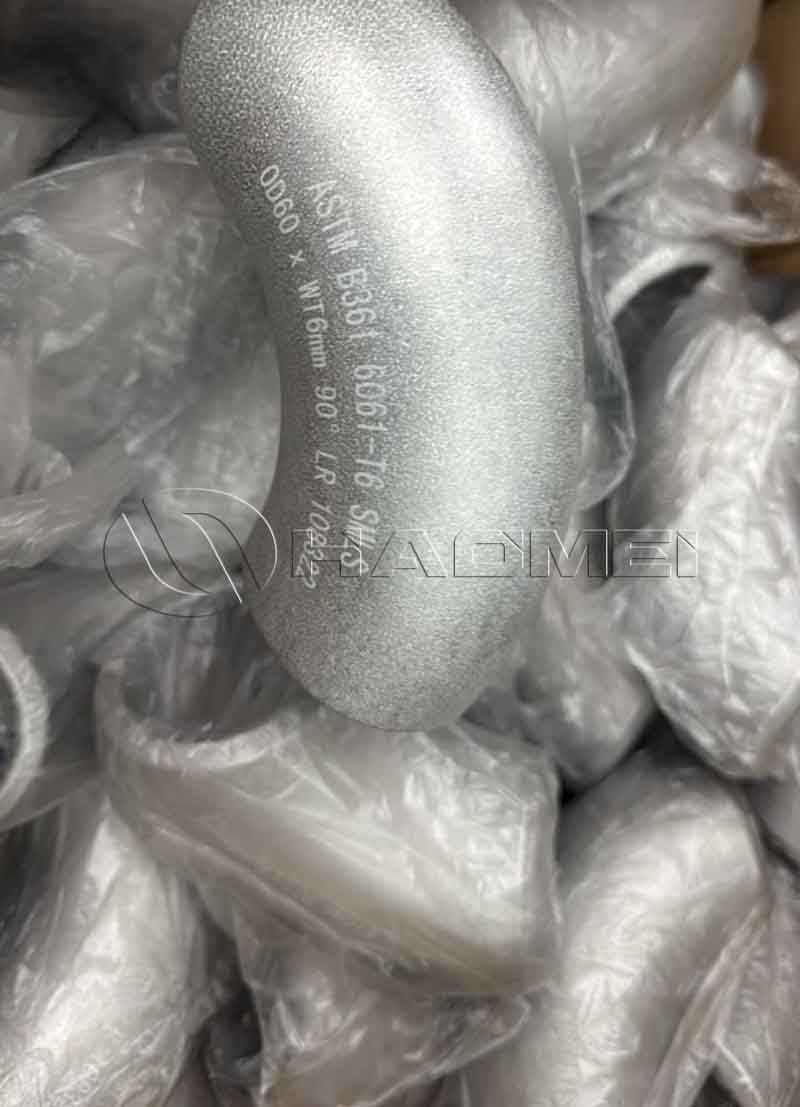
Among the most common alloys for marine pipe components are 6061, 6082, and 5083. Each alloy has different strengths and should be selected according to the pressure level, fluid medium, manufacturing method, and exposure conditions.
6061 Aluminum Alloy
6061 is one of the most common aluminum alloys used for machined marine components. It belongs to the 6000 series and contains magnesium and silicon, giving it a useful balance of strength, corrosion resistance, weldability, and machinability. In the T6 temper, 6061 is especially popular for precision-made fittings, threaded adapters, hose ends, manifolds, flanges, and connection blocks.
For marine equipment manufacturers, 6061 is often selected when a component requires accurate threads, smooth sealing surfaces, or complex internal passages. It can be machined efficiently into hose barbs, AN-style fittings, threaded elbows, reducers, and custom fluid connectors. Many aluminium hose fittings used in marine cooling, oil circulation, freshwater, and fuel-transfer systems are produced from 6061 because of its stable machining performance.
Although 6061 has good general corrosion resistance, it is not always the best choice for permanent direct contact with seawater. In highly saline environments, especially where protective coatings are damaged or galvanic corrosion is possible, additional surface protection may be needed. Anodizing, powder coating, marine-grade paint, and proper electrical isolation from dissimilar metals can improve service life.
6061 is therefore well suited for protected marine systems, engine-room connections, freshwater lines, and machined components that require high dimensional precision.
6082 Aluminum Alloy
6082 is another widely used 6000-series aluminum alloy. It is known for its higher strength in comparison with many standard 6061 applications, while still providing good corrosion resistance and weldability. It is often used in transportation, shipbuilding structures, offshore equipment, frames, brackets, and heavy-duty mechanical parts.
For marine pipe elbows and connection bodies, 6082 can be a strong option when the component must withstand vibration, mechanical loads, or moderate pressure. It is particularly useful for larger fittings, structural pipe supports, reinforced flanges, and elbows installed in areas where impact resistance is important.
Like 6061, 6082 is not generally considered the first option for unprotected long-term seawater immersion. However, with suitable finishing and careful system design, it can perform reliably in many marine applications. Designers should pay close attention to galvanic corrosion when aluminum parts are connected to stainless steel, brass, bronze, or copper-based components.
Insulating washers, compatible coatings, non-conductive sleeves, and proper drainage can help prevent corrosion caused by direct contact between different metals. When properly protected, 6082 offers a good combination of strength, cost efficiency, and fabricating flexibility for marine pipe systems.
5083 Aluminum Alloy
5083 is one of the most important aluminum alloys for marine environments. It belongs to the 5000 series and contains magnesium as its primary alloying element. Unlike heat-treatable 6000-series alloys, 5083 develops its strength mainly through strain hardening rather than heat treatment. Its key advantage is outstanding resistance to seawater corrosion.
Because of this corrosion performance, 5083 is widely used in shipbuilding, boat hulls, offshore platforms, deck structures, tanks, marine vessels, and seawater-related equipment. It is especially valuable in applications where aluminum parts may experience regular salt spray, humidity, or direct contact with seawater.
For pipe elbows, fabricated connections, welded assemblies, and seawater-handling sections, 5083 can be a preferred material. It has excellent weldability and maintains good strength after welding, making it suitable for custom marine piping layouts and fabricated elbows. A 90 degree aluminum pipe elbow made from 5083 can be particularly effective in seawater cooling lines, ballast-related systems, drainage lines, and other corrosion-sensitive installations, provided that pressure requirements and wall thickness are correctly engineered.
Compared with 6061, 5083 may be less suitable for highly detailed machining or fine threaded components, depending on the product design. It is generally more commonly used in plate, sheet, tubing, and welded fabrications than in small precision-machined fittings. Nevertheless, its superior seawater resistance makes it an excellent choice where corrosion protection is the primary concern.
Material Selection Considerations
Selecting aluminum for marine piping is not only about choosing the strongest alloy. The operating environment and fluid type are equally important. For freshwater, oil, fuel, air, and protected engine-room systems, 6061 can be a practical and economical option. For stronger structural fittings and larger mechanical supports, 6082 may offer additional load-bearing capability. For direct seawater exposure, welded marine structures, and corrosion-critical pipe sections, 5083 is often the preferred alloy.
Surface treatment should also be considered. Anodizing can improve surface durability, while marine coatings can provide an additional barrier against saltwater and atmospheric corrosion. Designers should avoid trapping moisture around fittings and should isolate aluminum from incompatible metals wherever possible.
By selecting the proper alloy and applying suitable corrosion-control measures, marine equipment manufacturers can create hose fittings and pipe elbows that are lightweight, durable, and reliable throughout long service periods at sea.