

Which Is More Popular in Shipbuilding: 5083 VS 5383
5083 aluminum alloy is currently more popular in shipbuilding, serving as the preferred material for both civilian and conventional military vessels. While 5383 aluminum sheet , an upgraded version of 5083, boasts superior performance, its application is primarily limited to high-end, high-requirement shipbuilding projects due to process requirements and cost factors, and it has not yet achieved widespread adoption.
Why is 5083 aluminum more popular?
The core reason aw 5083 has become a staple in shipbuilding lies in its well-rounded performance with no significant weaknesses, along with mature processes and cost advantages. Specifically, this can be summarized in three points:
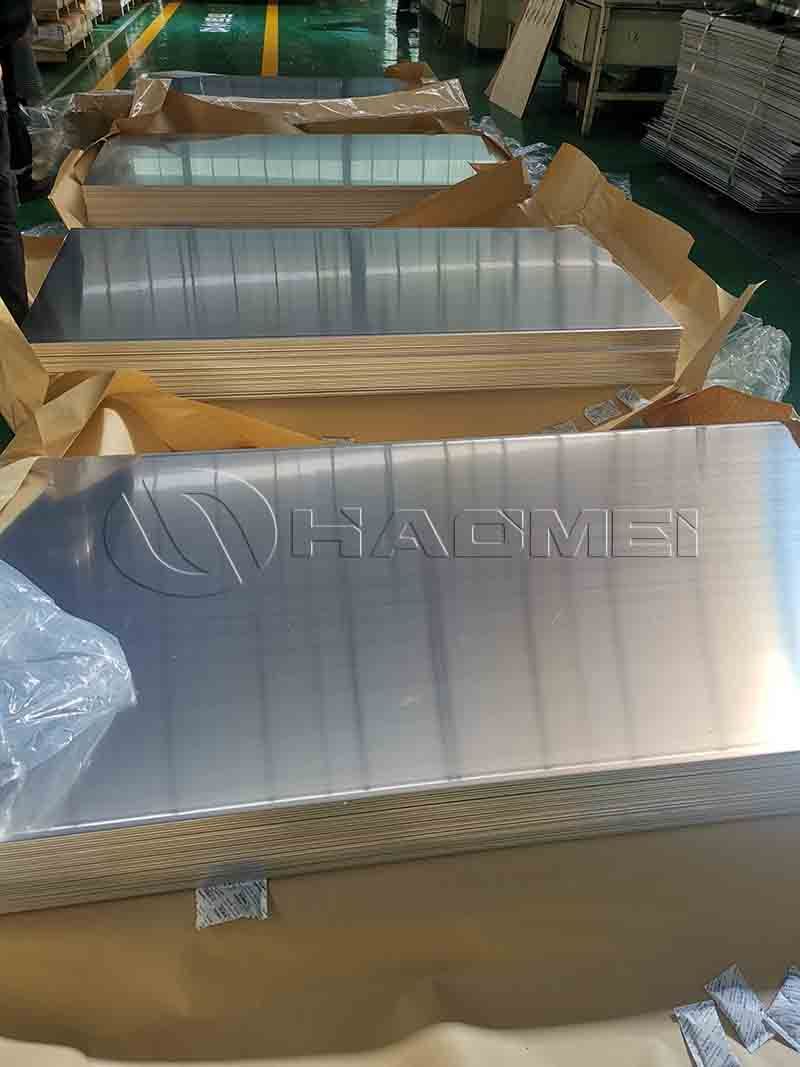
1. Strong adaptability to various marine applications. As a classic aluminum-magnesium alloy, 5083's magnesium content is controlled at 4.0%-4.9%, combined with trace amounts of manganese and chromium, forming a dense oxide film that provides excellent corrosion resistance in seawater environments.
Its corrosion rate in a 3.5% NaCl solution is only 0.02 mm/year, far exceeding that of ordinary carbon steel. Even in areas like the hull plating and waterline that are constantly submerged in seawater, it maintains long-term stability.
Meanwhile, its mechanical properties are well-balanced. In the O state, its tensile strength reaches 270-310 MPa, and in the H321 state, its yield strength can be increased to over 215 MPa, balancing strength and ductility. It can withstand wave impacts and adapt to the forming requirements of complex hull curves, making it suitable for most ship structural components, from decks and engine mounts to side plating.
Furthermore, its weldability is excellent, with a welding joint efficiency of up to 95%. When using 5356 welding wire for MIG welding, the weld strength can reach 90% of the base material. During the construction of a liquefied natural gas carrier in Shanghai, the cumulative length of 5083 alloy welds exceeded 3 kilometers, with an X-ray inspection pass rate of 99.2%, fully meeting the process requirements for large-scale ship welding.
2. Mature technology and stable supply chain. The production process of 5083 alloy has been well-developed through long-term iteration. From smelting and rolling to annealing, the technical threshold is relatively low, and most aluminum processing companies can achieve stable mass production.
For example, 5083-H116 aluminum plates, processed using a standard "hot rolling-intermediate annealing-cold rolling-stabilized annealing" process, can meet ASTM standards for resistance to intergranular corrosion, with a short production cycle and controllable costs. Furthermore, it has a large market share, a global supply chain, and convenient procurement for shipyards, eliminating concerns about material shortages.
3. Significant cost advantage and outstanding cost-effectiveness. Compared to 5383 aluminum , 5083 aluminum plate has lower requirements for alloy composition control (such as higher upper limits for impurities like iron and silicon), allowing for greater flexibility in process adjustments during production, thus resulting in a more cost-effective approach.
For most civilian vessels (such as yachts, fishing boats, and high-speed passenger ships) and conventional workboats, the performance of aluminium 5083 fully meets the requirements, eliminating the need to pay extra for higher performance, making its cost-effectiveness far superior to other alloys.
5383 Aluminum Alloy
AA5383 is an alloy optimized from 5083 alloy, with a core focus on "higher performance and more demanding environments." Its emphasis differs significantly from 5083, with its main advantages concentrated in improved strength and corrosion resistance:
1. Higher strength and less performance degradation after welding. By increasing magnesium (4.0%-5.2%) and manganese (0.70%-1.0%) content and reducing impurities such as iron and silicon, 5383 exhibits significantly improved mechanical properties compared to 5083 aluminum.
While its tensile strength is comparable to 5083 aluminum, its yield strength after welding can increase by approximately 15%. This reduces the number of welds or plate thickness in hull structures, reducing hull weight while improving structural integrity.
This characteristic makes it particularly suitable for high-stress scenarios, such as high-speed boats, hydrofoils, and other vessels requiring high-speed navigation and withstanding significant fluid resistance, as well as structural components in offshore platforms that withstand long-term wind and wave loads.
2. Superior corrosion resistance, suitable for extreme marine environments. Prolonged exposure to high temperatures or harsh marine environments can lead to problems such as intergranular corrosion and stress corrosion cracking in 5083 aluminum. 5383 alloy , through composition optimization and special stabilization treatment, addresses this issue.
Experiments show that after 7 days of artificial aging at 100℃, 5383 alloy significantly outperforms 5083-H116 in intergranular corrosion and stress corrosion cracking tests. In natural marine exposure tests, its corrosion resistance is also superior, thanks to its lower iron content and finer grain structure.
However, it's important to note that 5383 aluminum requires specialized stabilization annealing to adjust the distribution of the Al₃Mg₂ phase, changing it from a continuous to a discontinuous distribution, in order to fully realize its corrosion resistance advantages. This increases the complexity of its manufacturing process.
3. Suitable for high-end marine projects and certified by authoritative bodies. 5383 aluminum sheet has obtained certifications from several international authoritative organizations, including ABS (American Bureau of Shipping), BV (British Detachment of Shipping), and DNV (Det Norske Veritas), meeting the stringent safety and reliability requirements of high-end marine vessels.
Currently, it is mainly used in scenarios with extremely high performance requirements, such as key structural components of large cruise ships, low-temperature resistant components of polar vessels, and high-speed military boats. These projects are willing to pay extra costs for higher performance.