

FSW Plate
Define the product before placing an order
FSW plate generally refers to an aluminum plate or panel joined by friction stir welding, a solid-state process. A rotating, non-consumable tool generates heat through friction and deformation, plasticizing the aluminum without melting it. The resulting joint has no fusion-weld solidification structure, which can reduce distortion and avoid common fusion-welding defects such as porosity and hot cracking.
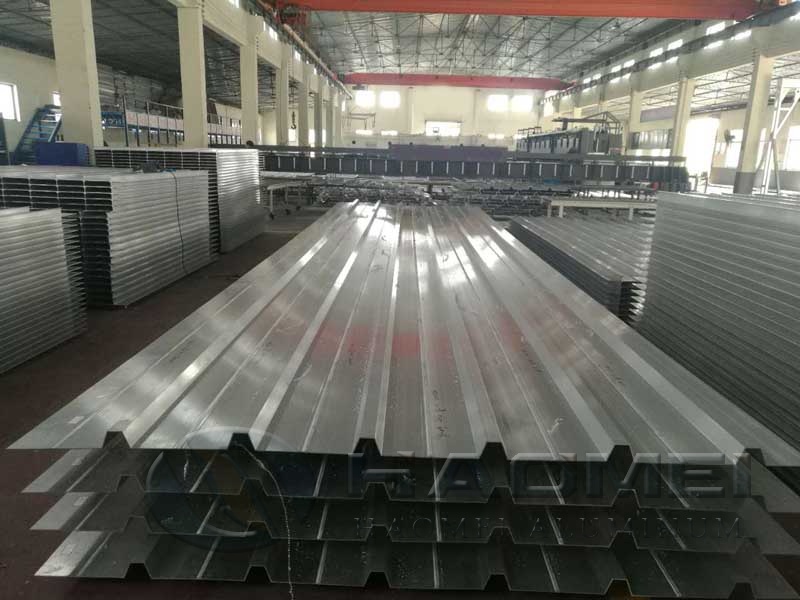
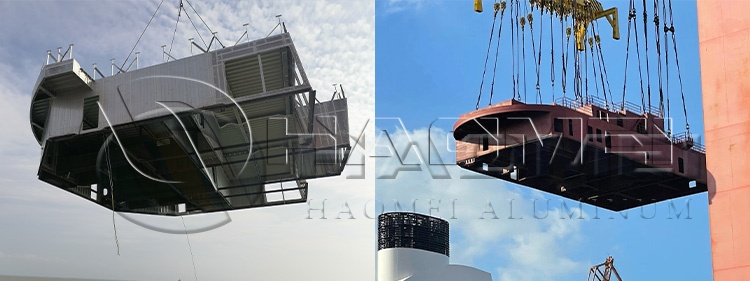
For shipbuilding, the term may describe flat panels, ribbed or extruded panels, deck plates, hull modules, or wide plates made by joining multiple sheets along longitudinal seams. Procurement documents should state whether the order is for a base plate, a friction-stir-welded panel, or a panel with integral stiffeners. These are not interchangeable products.
The main concern: verify weld-zone performance, not only base-metal grade
A 5083-H116 base plate can have valid mill certification while the welded panel still fails dimensional, mechanical, or corrosion requirements. Friction stir welding changes the temper in and around the joint. In strain-hardened 5xxx alloys, the heat-affected region normally has lower strength than the unaffected parent material.
For marine structures, acceptance should therefore be based on the completed panel and its documented weld procedure, rather than on base-material certificates alone.
Standards commonly specified
| Requirement area | Relevant standard or rule | Practical purchasing use |
|---|---|---|
| Aluminum sheet and plate | ASTM B928/B928M | Covers high-magnesium aluminum-alloy sheet and plate intended for marine service and similar environments. |
| Aluminum alloy chemistry and temper | EN 485 series | Defines technical delivery conditions, mechanical properties, and tolerances for wrought aluminum sheet, strip, and plate. |
| Friction stir welding quality | ISO 25239 series | Establishes terminology, design, quality requirements, and inspection principles for friction stir welding of aluminum. |
| Welding procedure qualification | ISO 25239-3 | Supports qualification requirements for welding procedures. |
| Inspection and testing | ISO 25239-5 | Covers inspection and testing expectations for friction stir welded joints. |
| Ship classification approval | DNV, ABS, Lloyd's Register, or vessel-class rules | Confirm the applicable class society and approval route for the vessel project before production. |
ISO 25239 applies specifically to friction stir welding of aluminum. It should not be treated as a material specification for stainless steel pipe, titanium, or conventional arc-welded structures.
Specify the panel in measurable terms
Avoid descriptions such as "marine-grade FSW panel" without defined acceptance criteria. The purchase specification should identify the following items.
Alloy and temper: State each component separately, for example 5083-H116 skin plate and 6082-T6 extrusion. Do not assume the panel retains the base-material temper beside the seam.
Plate dimensions and seam arrangement: Include thickness, width, length, number of seams, seam centerline location, and permitted edge trim.
Joint configuration: Identify butt joint, lap joint, or skin-to-extrusion weld. Record root support, run-on/run-off tabs, and final tab removal requirements.
Mechanical acceptance location: Require tensile test specimens transverse to the weld. The lowest-strength region commonly governs the result.
Flatness and distortion: State maximum local and overall deviation, measurement span, support method, and whether measurements occur before or after machining.
Surface condition: Define permissible tool shoulder marks, flash, oxide staining, gouges, and post-weld machining requirements.
Where a wide panel is needed, an Aluminum FSW Plate with integrated stiffeners can reduce subsequent joining operations. However, its specification must include stiffener geometry, weld spacing, panel deflection limits, and access for non-destructive examination.
Test plan for production acceptance
The inspection plan should distinguish procedure qualification from production testing. A successful sample panel does not automatically demonstrate consistency across every production weld.
Recommended documentation package
| Document or record | What to check |
|---|---|
| Material test certificate | Alloy, temper, heat number, chemistry, mechanical properties, thickness, and traceability to each incoming plate or extrusion. |
| Welding procedure specification | Tool design, rotation speed, travel speed, plunge depth, tilt angle, clamping arrangement, joint design, and permitted operating window. |
| Procedure qualification record | Test-panel results, specimen locations, macrosections, tensile data, bend results where specified, and inspection findings. |
| Production weld log | Panel ID, machine ID, operator, parameter record, start/stop locations, tool identification, and repair disposition. |
| Dimensional report | Thickness, width, length, seam position, flatness, twist, and stiffener location against the drawing. |
| NDT report | Method, calibration details, scan coverage, indication position, acceptance standard, and inspector qualification. |
Visual examination should identify surface-breaking defects, excessive flash, incomplete consolidation indicators, and unacceptable start/stop zones. Macrosection examination is useful for verifying weld nugget shape, root penetration, lack of voids, and the relationship between the weld and adjoining extrusion features.
For internal discontinuities, phased-array ultrasonic testing or conventional ultrasonic testing may be specified when panel geometry and acceptance criteria permit reliable coverage. Radiography is less suitable for some planar FSW flaws because tightly closed kissing bonds may not create sufficient density contrast. Select the method based on the defect mechanism and qualify it on representative reference samples.
Compare FSW panels with fusion-welded plate assemblies
| Factor | Friction stir welded aluminum panel | MIG-welded aluminum assembly |
|---|---|---|
| Heat input | Usually lower than arc welding | Higher local heat input |
| Filler metal | No filler wire in the FSW seam | Filler selection is required, commonly 5xxx series for 5xxx base alloys |
| Distortion control | Often favorable for long straight seams with rigid clamping | May require greater allowance for shrinkage and correction |
| Typical seam defects | Void, tunnel defect, kissing bond, lack of root consolidation, surface galling | Porosity, lack of fusion, hot cracking, undercut, overlap |
| Process limitations | Requires specialized equipment, robust fixturing, and tool access | More adaptable to complex geometry and field work |
| Acceptance focus | Parameter control, macrostructure, joint integrity, flatness | Welder qualification, filler control, fusion quality, distortion |
FSW is particularly suitable for repetitive, long, straight seams in controlled factory production. It is less suitable where access is restricted, the seam path is highly variable, or on-site assembly is required.
Sourcing controls that prevent avoidable disputes
Use a first-article panel before releasing the full production schedule. The first article should be made using the same material source, thickness, joint configuration, machine, tooling family, and inspection method planned for supply.
Include these controls in the contract:
Require traceability from finished panel to base-material heat or batch.
Freeze the qualified parameter window. Changes to tool geometry, rotation speed, travel speed, or clamping method require documented review.
Define whether repairs are permitted. A local fusion-weld repair changes the joint type and may require separate approval.
Require removal or treatment of run-on and run-off areas where they fall outside the finished dimensions.
State packaging controls for marine aluminum: dry separators, non-staining protection, edge protection, and no carbon-steel contamination during storage or transport.
Confirm whether class-society witnessing, material approval, or project-specific survey records are required before manufacture.
For panels exposed to seawater, retain the alloy and temper restrictions stated by the vessel design authority. ASTM B928/B928M is commonly referenced for marine 5xxx plate because it addresses material intended for marine service, but it does not replace project-specific corrosion, welding, or classification requirements.